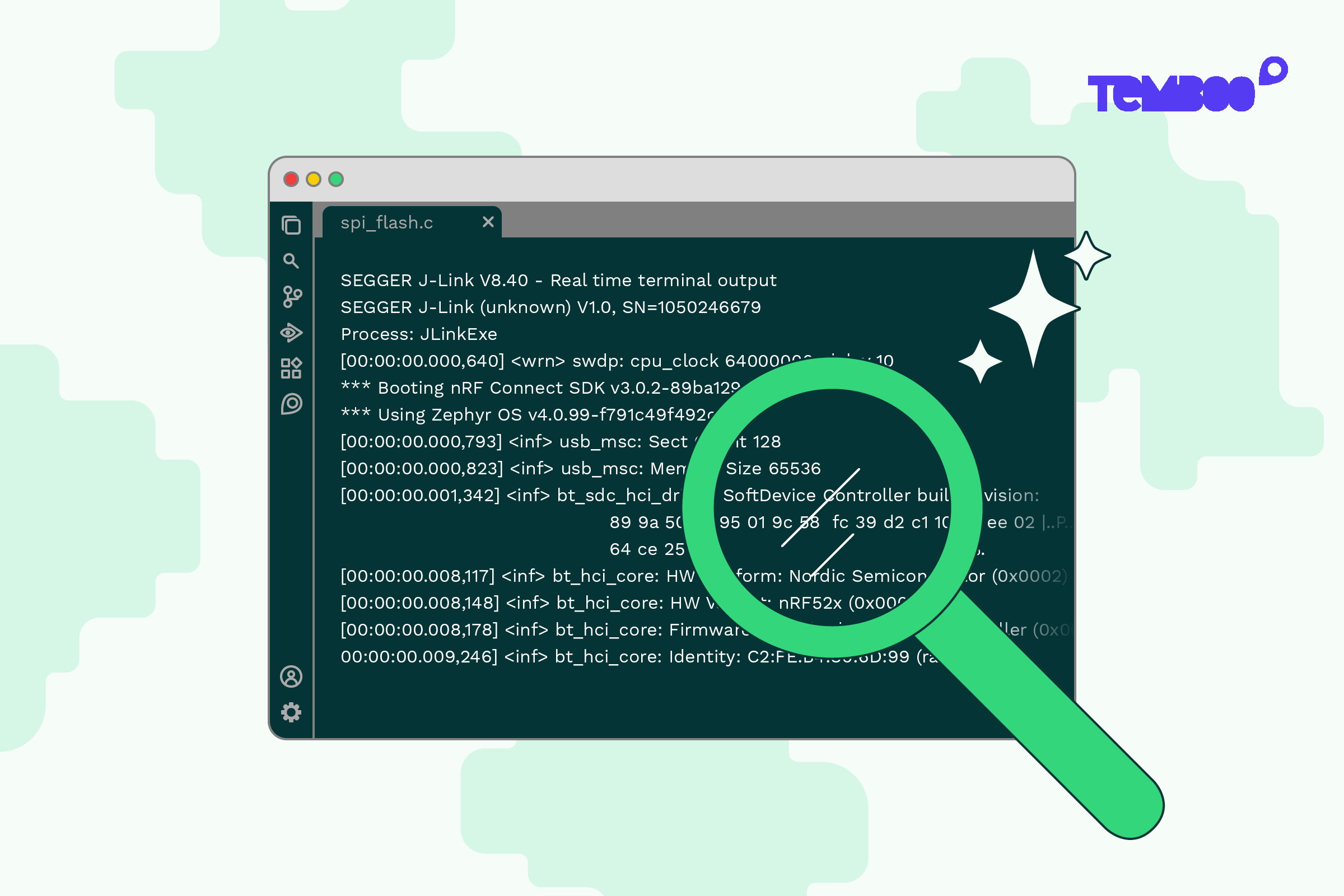
Some of the hardest problems in embedded development only appear after your code compiles. You build, flash, and then try to figure out if your device is actually working in the way that you’d intended.
This is where embedded development diverges from most other types of software engineering. Once a system is running, it’s no longer just code. Rather, it becomes a complex series of interactions between software, peripherals, interrupts, the physical world, and more. Many of the most taxing bugs only appear at runtime, and they’re often difficult to fix by looking at code alone.
Today, we’re introducing Runtime Analysis in the Temboo Agent — a new capability that enables the agent to inspect your device’s runtime output so that it can help you understand and debug behavior as it happens.
This new feature allows the agent to reason about your system as it runs, not just as it’s written.
How It Works
Imagine that you’re working with the Temboo Agent as normal — generating code, refactoring, debugging, and so on. When you make a code change, the agent will suggest building and flashing to see the change in action.
After flashing, the agent can now offer to temporarily monitor your runtime output so it can verify that the change is working as expected. The agent can also ask you to help it out by taking physical actions at runtime. For example, it might ask you to press a button, breathe on a sensor, unplug a peripheral, or whatever makes most sense for your application.
The agent observes runtime output, interprets what’s happening, and reports back to you. You can see it in action below.

You can trigger runtime analysis anytime, not just when building and flashing. If you’re seeing unexpected runtime behavior and want the agent to take a look, just ask it to start monitoring the output.
On one hand, this update feels like a natural extension to the agent’s behavior, and it integrates seamlessly into the current agent workflow. On the other hand, it opens up a whole new style of development that’s worth exploring in more detail.
Why Embedded Runtime Matters
In most software environments (web / desktop / mobile), debugging happens primarily in code. Inputs are well-defined and discrete, environments are predictable, and failures are often easily reproducible.
Embedded systems are different because the code interacts with:
- Sensors and actuators
- Hardware peripherals
- Interrupts and timing constraints
- Noisy or unpredictable inputs
- Inherently complex physical environments
This means that many bugs are not purely code bugs. They’re system bugs i.e., issues that only appear when code interacts with real hardware under real conditions. Typical embedded bugs look like:
- A button interrupt that fires intermittently
- A sensor reading that is noisy or delayed
- Initialization timing that causes a peripheral to fail
- Power management that affects runtime behavior
- A wireless signal that degrades under certain conditions
Often, these issues often can’t be diagnosed from looking only at your code. They require runtime observation and real-world experiments.
Our new Runtime Analysis feature allows the Temboo Agent to participate in this process. Instead of asking you what happened, and having you paste output logs into your prompts, the agent can observe what actually happened and figure things out for itself.
A New Kind of Human–Agent Collaboration
One of the most interesting aspects of this new feature is how it facilitates a new type of collaboration between you and the agent.
In non-embedded coding workflows, AI agents can generate code and then proceed to fully testing system behavior. In the embedded context, a more interactive human-agent relationship is required, because AI agents can’t easily reach into and affect the physical world like you can.
So the Temboo Agent may say to you:
“I’m monitoring runtime output. Please press the button once.”
You press the button. The agent observes the output and responds:
“I didn’t detect a button event. It looks like the interrupt may not be configured correctly.”
This creates a new kind of collaborative workflow:
- The agent generates, builds, and flashes code
- You interact with the physical system (perhaps after making a testing plan with the agent)
- The agent observes runtime behavior
- The agent analyzes behavior and modifies the code as necessary
This back and forth is particularly well suited to embedded development, where many tests involve physical interactions that cannot be sufficiently simulated. The developer becomes a key part of the test loop, performing physical actions, while the agent interprets responses. In essence, you and the agent are teaming up for a very modern “best of both worlds” debugging workflow.
Runtime-Aware Code Generation
Runtime Analysis also opens the door to runtime-aware code generation. The idea is that since the agent knows it can inspect runtime output, it can write code differently ahead of time so that it makes the most of its new runtime capabilities. For example, it can opt to:
- Add logging at key initialization points
- Print sensor readings for validation
- Report on state transitions
- Highlight error conditions
By explicitly giving the agent the knowledge that it has access to runtime output, it can know ahead of time to generate code that is easier to verify and debug at runtime. So now the agent is not just generating code for you, it’s generating code designed to be observed and validated in the real world. As you’re no doubt aware by now, this is particularly valuable in embedded systems, where observability is often limited and runtime issues can be frustratingly opaque.
It’s features like this that make the Temboo Agent a truly embedded-native product, and set it apart from general purpose AI coding tools.
Why This Matters
Embedded development has always involved a cycle:
Write code → Flash device → Observe behavior → Iterate
Runtime Monitoring brings the Temboo Agent into that loop for the first time. Instead of helping only at the code level, the agent can now help at the system level, where software, hardware, and the physical world meet, and where the trickiest bugs lurk.
We’re excited to see how you use runtime monitoring, and where this new style of human–agent collaboration in embedded development takes us all.
Try It Now
Runtime Monitoring is available now in the latest version of the Temboo Agent.

You must be logged in to post a comment.